THE SOUTHWESTERN · JUNE 2022
A Bird in the Band
Summer festivals offer insight into small but mighty species.
Words & Photos by Joe Richardson
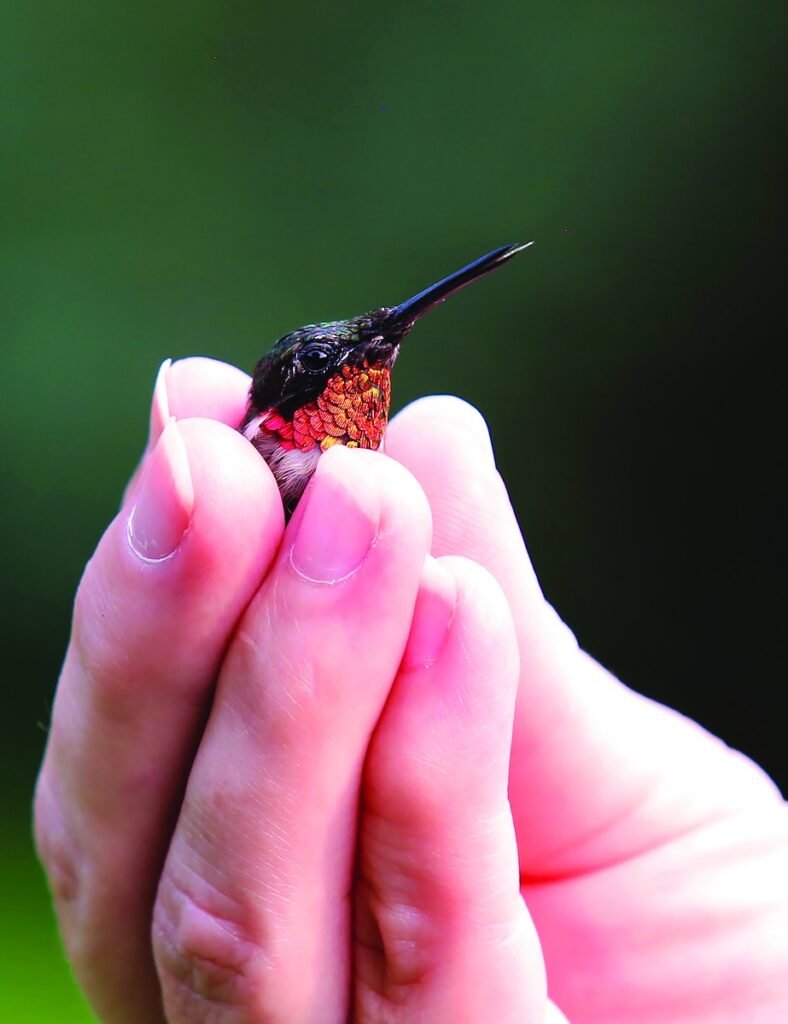
Let’s try a little magic. Pull a five-dollar bill from your pocket. Fold it, fold it, fold it again. Place it in your palm. Now imagine I cover your hand with mine, and when I move it away, in place of the paper sits a bird with umber eyes, a needle-long bill, and metallic green plumage that shines iridescent in the afternoon sun.
The bird is soft and still and very alive, and you feel the heat of it seep into your skin.
Now turn your hand. If the feathers at its throat shift from sunset-orange to black and back in the changing light, the bird’s a male. If the feathers are the color of dandelion down, it’s a hen. Either way, you’re holding a ruby-throated hummingbird, the sole species of hummingbird that makes it a habit to nest east of the Great Plains.
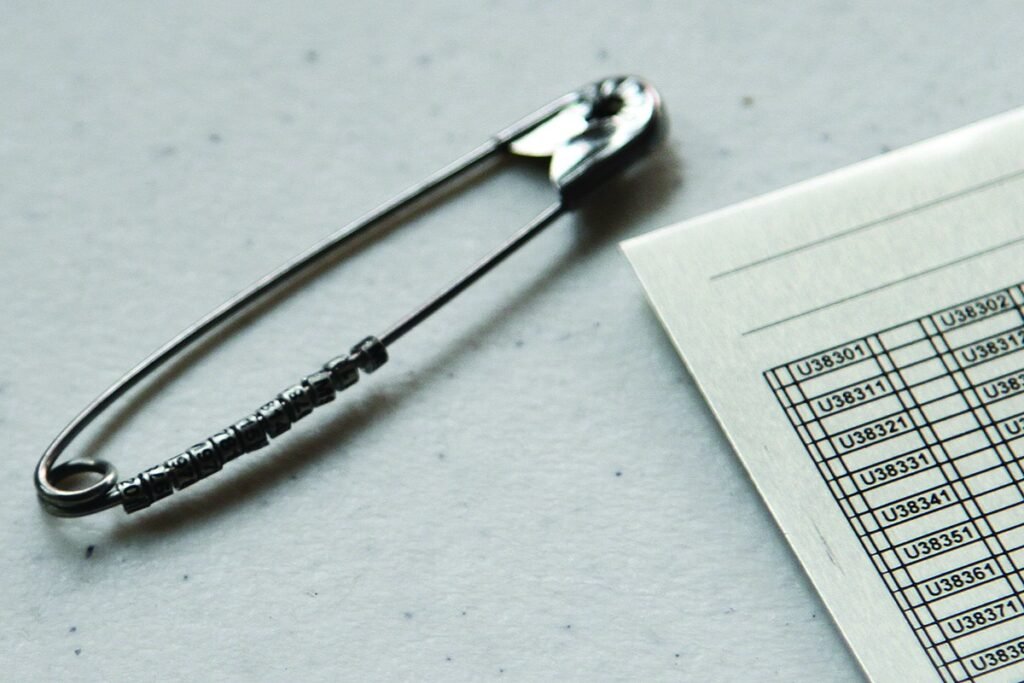
If the bird’s in no hurry to leave—and they often aren’t—you may see an aluminum alloy anklet ringing the leg above its toes. An ornithologist attached the band, years or minutes ago. You’ll need sharp eyes to read the code—essentially an avian social security number—stamped in the metal.
At some point the bird will take wing. Or you’ll tap the back of your hand and gently jostle it into action, because a bird’s got to eat, and this bird needs to eat more often than most.
You’ll feel a brush of air, and this tiny creature with a frantic heartbeat, a miracle of feather and bone that’s flown from Florida or Central America or the Yucatan and crossed the Gulf of Mexico to land in your hand, a bird so small it’s on the menu of some insects, that weighs less than a nickel and can hover, lift, spin, reverse, drop and turn on a dime, will have vanished.
But the magic isn’t over.
Later, if you’re very lucky, a letter may appear in your mailbox. It’s from Vernon Kleen, an ornithologist with the Springfield-based Lincoln Land Association of Bird Banders (LLABB). The $5 you parted with earlier was a donation supporting avian science. In effect, it earned you postcards from the road. If your hummingbird reappears at one of Kleen’s banding stations, he’ll send a letter apprising you of the bird’s travels. Kleen posts between 125 and 150 letters annually.
Having banded birds for 62 years, Kleen himself is a bit of magic, racking up miles on his own annual migratory route, which carries him across Illinois in summer and in winter to Costa Rica. He’s one of about 1,600 ornithologists in North America licensed to band birds.
Together they maintain a database housed by the Bird Banding Laboratory (BBL) in Maryland, which, as you might guess—but probably wouldn’t—is run by the United States Geological Service (USGS). The USGS keeps records of a banded bird’s gender, approximate age when signs are evident, and the date and location of banding stations where the bird’s been apprehended and held for questioning.
The data clues ornithologists into changes in habitat, range, population and migratory patterns—species indicators impossible to gauge in birds on the wing.
Equal parts art and science, bird banding is a meticulous, precise and elegant act. You can catch performances at hummingbird festivals throughout Southwestern Illinois this summer.
Better yet, you can be part of the show.
A FESTIVAL TAKES FLIGHT
It’s a humid afternoon at the Worden Hummingbird Festival, July 2021, and the catch and release part of the performance has already been staged a few dozen times at the home of Jeff and Paula Lievers. Judging by the volume of ruby-throated hummingbirds that continue to flitter under nets draped over their feeders, banders will be at it all afternoon.
The Lievers’ property is prime hummingbird habitat. Their lawn is ringed by trees, there’s a pond nearby, and flowers and feeders are strategically stationed for optimal viewing. Avid wildlife watchers, the Lievers had already cultivated a healthy hummingbird population when a friend mentioned that the Edwardsville Garden Club wanted to host a hummingbird festival. The Club was searching for a site. That was five years ago. The event has grown by word of mouth and social media since.
“You get to meet so many people,” Paula Lievers said. “They ask a lot of questions. I feel really good that I can share the information and pictures we have, and all the knowledge that we’ve accumulated.”
Last year’s festival drew people from throughout Southwestern Illinois, upstate, and parts of Missouri.
“The first two hours of the fest are the busiest,” said Lievers, “because you’re trying to get the names and addresses of people signing up to adopt birds.”
Adoption is simple. Contribute $5 or so (contributions are voluntary) to offset costs involved in banding the birds. Your name and address are linked to a number on a band. An ornithologist at the festival will take measurements of a hummingbird, then fit the bird with a band. He or she will hand the bird to another member of the team.
They’ll hand it to you.
You’ll set it free.
Simple yet extraordinary.
You’ll receive an adoption certificate on the day and a letter each time your bird is caught by Kleen. “Some people will adopt five or 10 different birds for different people,” Lievers said, “or sponsor a bird as a memorial for somebody they’ve lost.”
ARRIVALS, DEPARTURES & LAYOVERS
Male ruby-throated hummingbirds typically arrive at the Lievers home in mid-April.
“They try to take over the feeder and they won’t let any other males or even any adventuring females get near it.”
The Lievers put up additional feeders to reduce competition. Hummingbirds nest nearby and spend the summer visiting flowers and feeders in their yard.
“The birds have to learn you have a feeder. It takes time,” she said. “You have to be really consistent. If you have a feeder out there, you have to make sure that feeder’s clean and has some liquid in it every day.”
Birds begin to feed in the morning.
“As soon as it starts getting daylight, they’ll be swarming. You can almost set your clock by them.”
Birds work the feeders again in the evening, before they settle into a deep sleep—a metabolic torpor—to conserve energy.
The performance is repeated daily from spring into summer. Older males begin departing in July and are gone by the end of August. Females and young juveniles may remain into October.
The Lievers watch other wildlife in autumn and winter, waiting for the birds to return.
At last year’s festival, between 2 p.m. and 5 p.m., Kleen and the LLABB banded 88 hummingbirds. The tally included 64 adult females, 12 adult males, 11 young females, and a young male. Eight of the birds had been previously banded. The afternoon ended with 45 adoptions.
“Until you’ve been to a hummingbird festival,” Lievers said, “you just don’t know what all the excitement is about.”
FOR THE BIRDS
Attend an Illinois bird banding festival north of Interstate 64 and you’re likely to meet Vernon Kleen. An ornithologist who retired from the Illinois Department of Natural Resources, Kleen is one of three people in the state licensed to band birds.
Each banded bird adds a point of color to the collective portrait of a species. The pictures painted by a database lack the artistry of John James Audubon, but they offer insight into the range, health and habitat of North American birds.
“Things you can’t tell,” Kleen said, “when they’re just up there flying.”
On some days Kleen is lucky to band five birds.
“Some places I catch over a hundred birds,” he said. “Sometimes it seems like we’re catching more birds, which is always a good sign.”
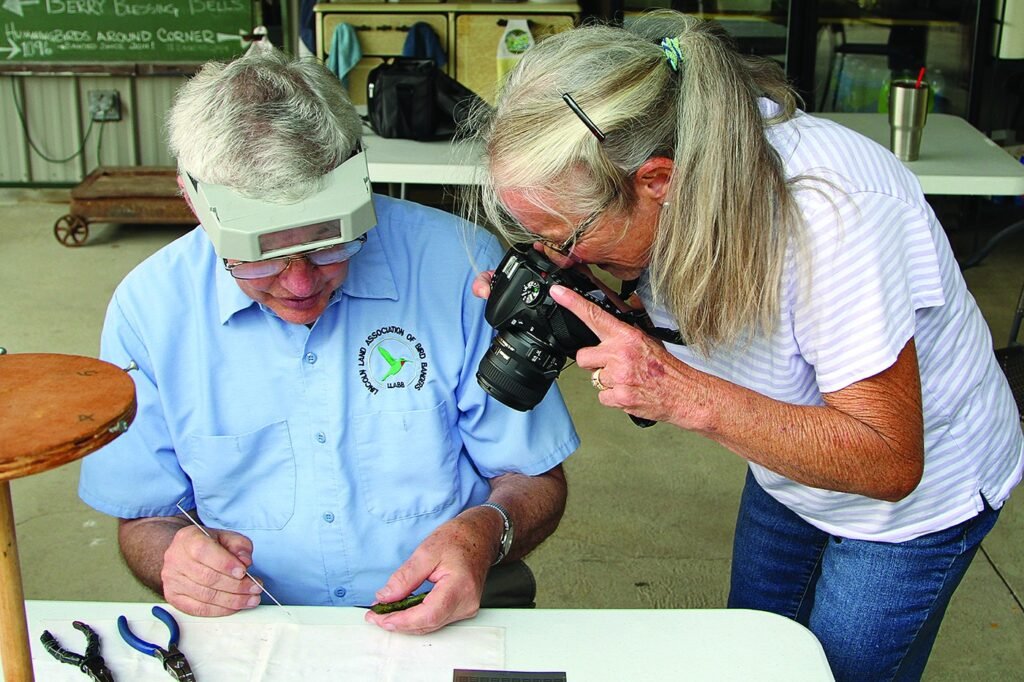
Kleen works with the care and precision of a jeweler setting a stone. At festivals he spends most of an afternoon head-down, looking through a visor fitted with a magnifying lens. Kleen examines each bird, takes measurements using calipers, and gently applies a band using pliers. The procedure takes less than two minutes.
“We want to have these birds in our hands for a very short time. We want to get the birds out there flying—we don’t want to deprive them of their food. That’s the reason they were caught,” he said. “They were hungry enough to try to get food.”
When you have the metabolism of a hummingbird—a heart that can top 1,200 beats a minute and wings that burn through 50-plus strokes per second—and maybe two mouths other than yours to feed, you’re always hungry. You eat frequently or you die.
And you make it a point to remember places where you picked up a good meal.
Stands to reason that Kleen encounters some of the same birds at feeding stations year after year.
In fall 2021, at a banding station in Litchfield, he caught 213 birds. Of those, 106 previously had been banded.
“Half of those birds used their GPS to find the exact same location where they had lived previously. They come back to the same spot, year after year.”
Impressive, given many of the birds winter in Mexico or Central America and follow a migration path of more than 1,000 miles over open water and changing landmarks.
Kleen’s bird banding season begins in March. Six days a week, from shortly before sunrise until noon, Kleen and his team work nets on the campus of Lincoln Land Community College in Springfield, Ill., where they catch and catalog a variety of species.
From the end of May through August the team will travel Illinois to band hummingbirds. They’ll spend late August through mid-November at the banding station in Springfield.
Kleen bands between 6,000 and 8,000 birds a year. Of those, about 3,000 are hummingbirds. He bands about 100 species annually.
The day of our interview he’d banded 118 birds.
“I just enjoy it. It’s fun teaching people and sharing experiences with them, so they learn more about birds.”
Kleen says the best thing you can do for birds is work with conservation agencies that preserve habitat.
“Habitat preservation is the primary success story for birds and all wildlife, for that matter.”
birds in bloom
Kay Stoecklin didn’t go looking for hummingbirds. The birds came to her.
“It was more that they demanded my attention,” she said.
The birds found her 20 years ago when she was working on her property south of Donnellson.
“I had a Ford Explorer and it had red taillights that were kind of big, and every time I was out there, the birds would be at my taillights.”
She mixed sugar solution and put out a feeder.
“They drained it in a heartbeat. So I got a second feeder.”
She hung the feeders from the branches of an oak. They were raided by raccoons. She rigged a rope and pulley from the high branches and hauled the feeders out of reach. The raccoons relented. The birds kept coming.
When she shifted a quarter mile west to work land that would become Stoecklin’s Orchard, she put out more feeders. The birds followed. Hummingbirds have found her feeders every summer since.
“I start with one feeder. I force them to drink all the nectar in a 48-hour period before I’ll throw out another,” she said. “I make sure it’s fresh and clean. I’ll only put out as much as they’ll take; I try not to put out extra because it’s going to go bad and you’re going to have problems.”
Stoecklin says birds usually arrive at her feeders around the first of May, about 10 days after they show up at other feeders in the region. The males show up first.
“The males will eat as they’re migrating north. They’ll stay for a night, or they may just drink their fill and go. I won’t have any resident birds for a while.”
She often hears the birds before she sees them.
“I know their chatter. I know that wing noise. That’s usually my first clue that they’re here. It’s not long after that I start seeing the pendulum swing—that’s the mating dance.”
Like Lievers, Stoecklin notes feeding frenzies at dawn and dusk.
“Especially during migration. You can come out here and see a hundred birds,” she said. “Every time they’ve nested and babies have fledged, I feel the nectar drain. I’m going through the stuff faster. So I put out more feeders and then I add more nectar.”
In early spring, she makes about three cups of sugar solution daily.
“At the end of summer I’ll be making three gallons a day,” she said. “In three months I go through 400 pounds of sugar.”
Kay and her husband, Phil, host two festivals at their orchard—one in June and one in July. “We try to catch the birds before migration starts, but after most of the babies have fledged from their second or third brood.”
Their festivals have become a popular regional event, in part because of the multitude of birds, but also due to the setting. You can watch Kleen band birds, then see them take flight while you sit with a blueberry field to the south, trees at your back, art on the lawn, and a sprawling farm field with a weathered barn breaking the horizon.
The venue communicates the values and personality of the people who call it home. Reverence and respect for nature are evident in Kay Stoecklin’s art, photography, and in the experiences she shares.
“Early on, might have been my second year, probably the end of summer, I had a lot of birds,” she recalled. “I was mowing, and the feeders ran out. I wasn’t paying attention. They started swarming me on the mower.”
She took a feeder inside to fill it.
“I walked out the back door and instantly I was swarmed by at least 40 birds. I didn’t move. I didn’t breathe. I just froze. There was a layer of birds. They were eating. There was a layer above them trying to eat. There was another layer above them.”
She stopped and stood a while, drinking in the moment, committing it to memory.
“Finally, I was able to start walking with this cloud of hummingbirds around me.”
Twenty years later, she’s still awed by the experience.
People who’ve gathered at Stoecklin’s Orchard on a July afternoon to adopt and hold a hummingbird are awed as well. Like Stoecklin, they’re moved by a moment that will linger in memory.
To keep something delicate, resilient, vibrant and alive in your care, if only for a handful of heartbeats, then to feel it take flight, is in every sense of the word, magic.