THE SOUTHWESTERN · MAY 2025
Living History
Cross a threshold into the past at Carlinville’s J.C. Anderson House
Words & Photos by Joe Richardson
It started life as a single-story wedding gift. In 1883, Carlinville banker Crittenden Anderson commissioned construction of a farmhouse for his son, John, and daughter-in-law Lucy. In 1892, the Andersons added a second floor for their growing family. By the time Illinois’ interurban system reached Carlinville in 1904, Anderson kids Jessie, John, Martha, Rivers, Lucile, Perry, James and Mary could watch railcars trundle through town from their home’s fourth-floor observation tower.
From turn-of-the-century grandeur through mid-century decline, the Anderson House stood as a sentinel at the city’s edge, witnessing the emotional toll of two world wars and an influenza epidemic, the economic impact of the Depression, and the rise and fall of the region’s coal and oil industries.
By the late 1960s, the old mansion was a place of rumor and ruin. Stories of murders, hauntings, Underground Railroad derring-do, and a chicken that perched in the parlor to lay eggs for Lucy Anderson circulated around town, students staged unsanctioned parties on the property, and souvenir hunters, vandals and thieves piled injury on insult.
“My classmates broke into this house and had wild parties,” recalled Janell Ramey, a Macoupin County Historical Society member, J.C. Anderson House museum docent and lifelong Macoupin County resident. “At school, I heard them talking about their wild weekends at the mansion. I actually talked my parents into driving by — I’d never seen the place.”
In 1973, the Macoupin County Historical Society bought the home. They’ve been restoring, conserving and showcasing the Anderson House and Macoupin County history ever since.
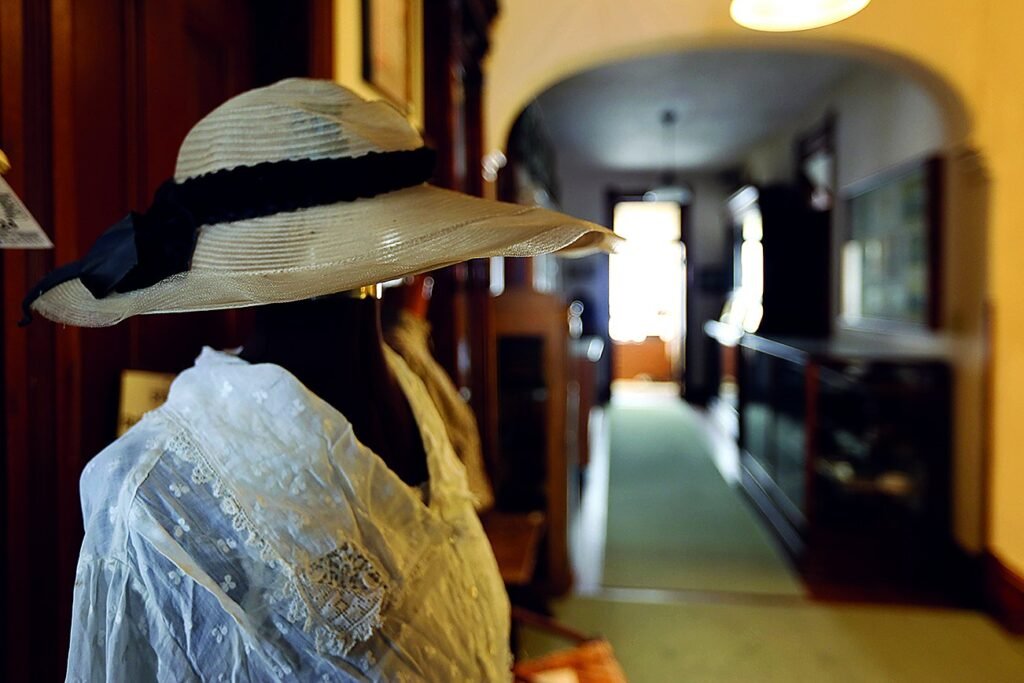
In the manse you’ll find carefully curated artifacts offering insight into early 1900s life, the evolution of Macoupin County, and days long past. Rooms, closets and passages showcase period furniture, musical instruments, military uniforms, antique clocks and radios, vintage books and historic clothing — including Lucy Anderson’s wedding dress. An alabaster statue that vanished generations ago and recently reappeared, courtesy an anonymous donor, sits on the mantel of a first-floor fireplace — one of eight, no two alike, that adorn the house.
While rich in relics, J.C. Anderson House is running short of a precious resource — volunteers.
“After World War II, when our people came back, they were into family and organizations — clubs,” Ramey said. “We had a strong sense of community then. Now our young people graduate from high school, they go off to college, and they may come back to visit, but they raise their families somewhere else.” As a result, our sense of community and connection to people who came before has eroded, Ramey said, and with it, our drive to preserve traditions, heritage and stories of the past.
– Janell Ramey
“Parents get their kids involved in sports to keep them busy and to give them exposure to other good kids,” Ramey noted. “There’s no time for church and clubs and other activities.”
That may be the rule, but there are exceptions. Ramey recalls a high school freshman who became fascinated with the museum’s military artifacts during a tour. What began as curiosity about a closet-turned-historical lockbox turned into four years of volunteer service. It’s a recurring theme. Many Macoupin County Historical Society members have specific areas of interest that draw them to the house and campus. “For some, it’s the old clothes,” Ramey noted, “for others it’s military history or old books.”
An array of exhibits and demonstration areas call to volunteers with specialized skills. Historical society members operate a printing press and blacksmith shop on the grounds. A former Blackburn College maintenance tradesman has restored antique radiators, Victrola and Edison phonographs and a battery-operated console radio that served farmers pre-Rural Electrification Administration. Another docent has a talent for developing exhibits. “She knows exactly what’s needed to tell the story and she searches until she finds it,” Ramey said. “She has made a tremendous difference here.”
Seated in the second-floor library, Ramey’s attention shifts to an early 1900s writing desk, the ledgers stacked atop it, art and artifacts on the wall above, and floor-to-ceiling shelves packed with 19th century books. An ardent preservationist, Ramey spent the Covid years reviewing and indexing the library. In the last 10 minutes she’s answered questions from docents, consulted on an exhibit, and acknowledged and approved maintenance plans. Time and again, she comments on the talent, care and commitment her colleagues bring to preserving, cataloging and displaying the home’s history, and the volume of work accomplished by a small corps of dedicated docents. “I’ve been here 10 years and I haven’t been through every closet yet,” Ramey says, noting volumes she’s yet to review. “I’m going to have to speed it up.”
As she reflects on the museum’s future, Ramey recognizes that preserving history requires an investment of time and care from generations to come. “There’s no reason a house that’s 140 years old has to crumble and fall. It comes down to labor. If you have volunteers, you can have fundraisers, you can apply for grants, and you can get the work done,” she says. “But you need people to keep history alive.”