THE SOUTHWESTERN · MAY 2022
Plugging Into Yesterday
As Route 66 celebrates its centennial, the growing popularity of EVs could offer America’s Main Street an economic push.
Words & Photos by Joe Richardson
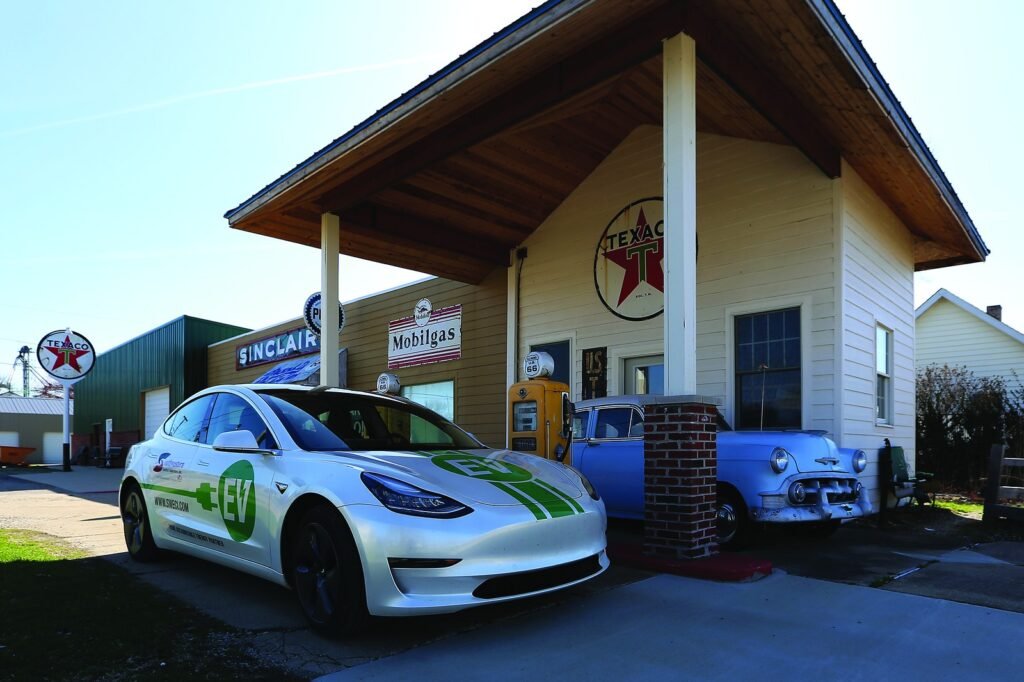
I’m parked on a no-name road in Logan County two dozen stops and a hundred miles north of where I started. Route 66 is to my left. Beyond the old highway, a steady stream of traffic moves up and down I-55. Wind turbines rise from fields further west. More turbines stand to the south. The skies are bright and a cold wind is burning across the prairie. The blades are turning at a good clip. To my right are acres upon acres of solar panels. More lay bundled in packages to the north, waiting to be deployed.
I’ve spent the day driving up Route 66, stopping at roadside attractions old and new. I’ve seen remnants of businesses that flourished and faltered as travel on America’s Main Street waxed, waned and shifted from one alignment to the next. I’ve followed highway signs marking an original iteration of the pavement from Hamel to Broadwell, Ill., all the while behind the wheel of an electric automobile. Both road and vehicle are testament to the ever-evolving nature of transportation in America.
It’s an odd intersection of time, purpose and place, standing in Central Illinois, surrounded by shiny black solar arrays and chalk-white wind turbines in a landscape ready-made for weather-beaten barns, watching traffic skirt a highway that’s connected Chicago to St. Louis for close to a century.
The juxtaposition makes me both uneasy and optimistic. Not so long ago this soil supported crops. Now it grows green energy. Things aren’t the way they were. But maybe they are as they need to be.
For the past to be preserved, it needs to remain relevant. After years of decline, Route 66 and its environs are poised to enjoy a renaissance of relevance. The panels and turbines that flank the highway are engines of clean energy. And ample, affordable, green energy can in part fuel the Route 66 revival by powering homes, businesses—and electric vehicles.
EVs and charging stations may not drive the economy of Main Street America or communities along the Mother Road—but as the highway’s centennial approaches, they can get out and push.
THE SHORT LIFE OF A LONG ROAD
The rise of automobiles and the development of reliable, well-marked, all-weather roads in America was a decades-long dance. In the early 1900s, roads were largely made of dirt, rock, brick or concrete. Rain and snow turned some well-traveled routes into rut-strewn slogs. Given the likelihood of road hazards, even if you owned an automobile, for long trips you might take a train. If you were traveling locally, say from Worden to Edwardsville, or making a day trip from Alton to Springfield, you could hop on the interurban—a regional electric train system.
But in Illinois, as in the rest of the nation, we preferred to travel when and where we pleased, making train travel less than ideal. So in 1921, the federal government funded a national highway system. That system included Route 66.
Commissioned in 1926, the highway stretched from Chicago to Santa Monica, Calif., stitching together new and existing pavements and hundreds of communities, uniting them under the Route 66 shield. Illinois’ segment of 66 had been plotted and paved two years earlier, as State Bond Issue Route 4. Already well-traveled, Route 4 connected Chicago to St. Louis, passing through dozens of communities large and small along the way.
Communities and businesses along Route 66 flourished. New service stations, diners, motor courts and roadside attractions appeared to accommodate travelers.
Better roads begat more traffic. More traffic spurred demand for better roads—and faster routes. Sections of Route 66 shifted to bypass bottlenecks. New alignments expanded into four-lane highways to accommodate larger vehicles and more traffic.
In 1956, President Dwight D. Eisenhower enacted the Federal-Aid Highway Act, creating the faster, broader, limited-access interstate system we know today. Interstates like I-55 ran parallel to Route 66 but looped to avoid downtown areas and businesses. Traffic on the Mother Road ebbed and all but died. The fortunes of small businesses which counted on 66 for sustenance followed.
In 1977, Route 66 was decommissioned in Illinois. By 1985, the shields were struck and Route 66 had vanished from maps across the country. The Mother Road was a memory.
It was a memory that refused to die. Regional associations formed to keep the spirit of the road alive. In 2005, the United States Department of Transportation awarded Route 66 scenic byway status. In Illinois, 400 miles of 66 alignments connect close to 100 communities. With centennial celebrations on the horizon and planning and preparation already underway, Route 66 stands to undergo a revival—and EVs are poised to contribute.
ELECTRIC HIGHWAY
A defining characteristic of Route 66 ultimately ended it. On its mosey across America, the highway overlapped Main Street, slowing travel each time it passed through a downtown area. Today, that same trait could reinvigorate it.
With COVID lockdowns and self-sequestering fresh in memory, people want to wander. They want to explore, make memories, connect.
Those things take time. More time than you need to charge an EV.
Just as service stations anchored commerce corridors in towns along 66, charging stations could anchor attractions today. Route 66 faltered when America valued the destination over the journey, and expedition over experience.
With words like productivity ingrained in our day to day, efficiency is the last thing we want to pursue on a weekend getaway or extended vacation. We want to slow down. We want to experience something unexpected, novel, unique.
Interstates are effective, but they largely lack character. In Illinois, I-55 passes through oceans of homogeneous countryside that lack the regional dialect of place. But take a two-lane through Illinois—through any state—and you drive through islands of architecture, craftsmanship, material, color, texture and history that can vary wildly inside a span of 20 miles.
As I traveled through Hamel, Litchfield, Staunton, Mt. Olive, Gillespie, Williamsville, Elkhart and Atlanta, I saw that every Main Street told a story. It was written in the ink of art and architecture, signs and storefronts, old buildings and new businesses. Each story was unique to the town.
Those stories are still being written. We can learn those stories. We can be part of them.
At present, America’s EV charging network is rapidly growing in cities and along interstates. Southwestern Electric installed two chargers near the interchange at I-55/70 and I-270 at Troy, and you can find banks of chargers near the I-70/I-57 interchange at Effingham.
You’ll find precious little in the way of public charging on Route 66. Between Hamel and Atlanta, Ill.—the midpoint of Illinois 66—you’ll turn up commercial chargers near I-55, but few if any in historic downtown districts.
But it’s early days. America’s public charging network, if not in its infancy, is an adolescent. There’s time to grow in new directions—including Main Street America.
Chambers of commerce launched inventive campaigns to draw Route 66 tourists to town. The same organizations could strategically site charging stations and pitch their attractions to EV enthusiasts—a demographic that isn’t confined to EV owners.
The romance of the Mother Road, as told in film, story and song, is alive and well overseas. Visitor logs and maps at Route 66 welcome centers in Litchfield and Atlanta read like a world atlas, with place pins bristling across continental Europe and metropolitan areas in the United Kingdom, Ireland, Iceland and Australia. You’ll also find signatures followed by towns and cities from every state in the Union.
These tourists are renting automobiles. Some of them have EVs at home. And some would certainly embrace the novelty of driving an electric car down Route 66 were it simple to do so.
Communities can make it simple. They can site EV chargers on or near Main Street. They can site them near classic service stations, in front of cafes, by murals and museums, near walk-in attractions and interpretive panels.
They could write electric vehicles into the latest chapter of a story that’s still being told. And they could invite Route 66 travelers to be part of that story, as they stop to recharge, pause and explore.
Only going to be in town for an hour? Top off at a town’s fast charger. Plan to stay overnight or spend a half-day touring sites on foot? Charge up at the town’s slower but cheaper Level 2 station.
Sound like a good idea? It is. But it isn’t mine. A town of 1,600 that sits at the heart of Illinois Route 66 is already moving in that direction.
PAST MEETS PRESENT
I’m shooting photos of an octagonal library on Route 66 when an amiable-looking gentleman steps from a hybrid Toyota Camry and crosses the street to ask me about Southwestern’s EV. His name is Jim Welchel, and he’s vice president of the library’s board of directors.
Like most libraries, Atlanta’s library isn’t about books. It’s about community. Unlike most libraries, this one owns several buildings along Route 66. The buildings house Atlanta and Route 66 museums, a welcome center, community space, and the historic Palms Grill Cafe.
Two minutes into our conversation Welchel invites me to show the co-op’s EV at Atlanta’s Route 66 EV event. Then he asks if I’d care to see the inside of their library. And the welcome center. And their museums.
For the next 90 minutes, we tour the town, inside and out. It will end up being the most memorable part of my day.
Atlanta’s downtown, which has catered to Route 66 travelers since the early days of the highway, maintains its architectural integrity, with a few added 66 elements to call tourists off the interstate. A block off Route 66 they’ve installed a Level 2 charging station. You can conveniently plug in, shop, dine and tour 66 attractions.
On April 16, the city will rope off a section of 66 a block away from that charger. In coordination with Plug In America, Atlanta has invited EV and hybrid automobile owners from near and far to participate in their EV event.
EV owners will introduce their cars to residents of Atlanta. Atlanta residents will introduce EV owners to their community. The meet will also act as an opportunity to exchange ideas about Route 66 tourism, EVs on the Mother Road, and methods to marry the two. As of early April, 24 vehicles representing 16 models of EV or hybrid—including Southwestern’s Tesla Model 3—were registered for the event.
SUNSET ON 66
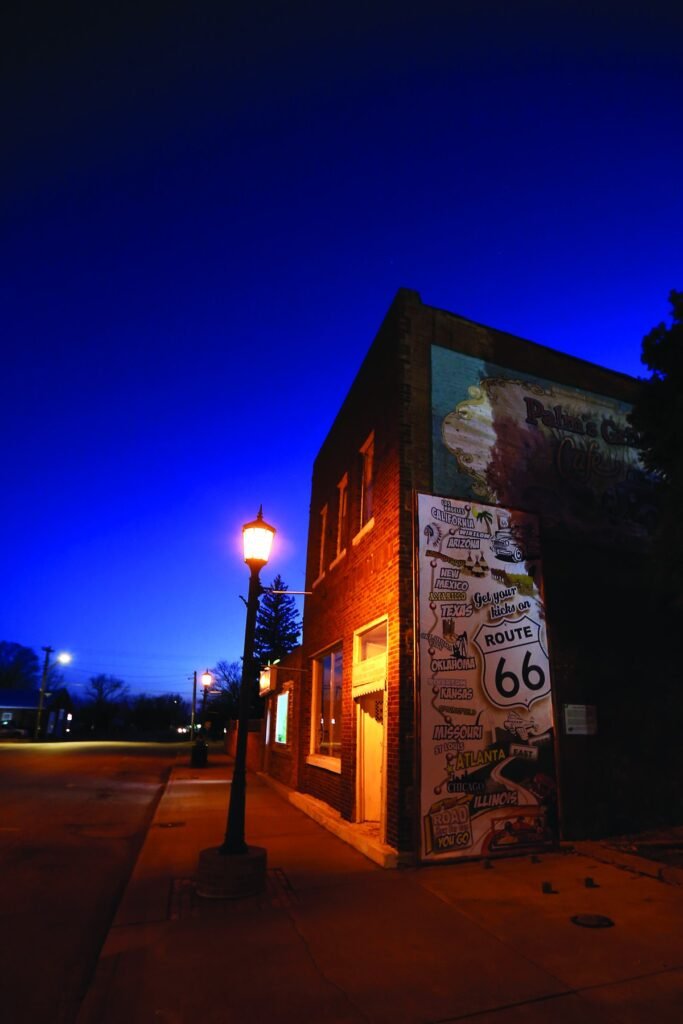
It’s 8 p.m. and the sun has set on Route 66. Welchel bids me farewell, hops in his hybrid and heads for home. Atlanta is tucked in for the night. The shops are silent, the library closed. But even now the downtown, this block of pre-Route 66 history and Mother Road Golden Age iconography, an oasis of small-town Illinois and new and old Route 66, is well lit and welcoming.
Atlanta isn’t the most iconic stop on Route 66 in downstate Illinois. But for me it’s the most memorable. Not because of the library, the cafe, the park, the mix of past and present, or the blend of community and kitsch. But because an Atlanta resident went out of his way to welcome a traveler.
Welchel personified hospitality. He shared his time, his town and his community spirit with a stranger. He demonstrated how a hometown welcome can reach beyond the people who call a town home, to people just passing through.
He turned a stop into an experience. At its best, this is what Route 66 was about. This is what it can be about, still.
People like Welchel give of their time and talent, and in return, because we’re wired that way, we give thanks the only way we know how—by sharing that generosity, that hospitality and hometown pride, with others—one traveler, one conversation, one experience at a time.
And so it goes on down the road.